
BAC #: 2380QT
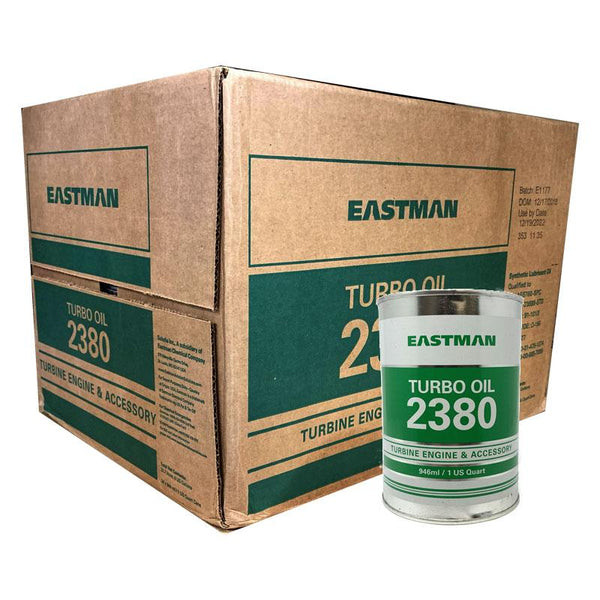
Eastman 2380 Turbine Oil, MIL-PRF-23699F Std
Description
Eastman Turbo Oil 2380 is a 5 cSt synthetic aviation turbine oil designed for commercial aircraft gas turbine engines and accessories. It provides a balanced combination of thermal and oxidation stability, load-carrying capability, low volatility and excellent low-temperature performance.
Turbo Oil 2380 is qualified to MIL-PRF-23699F Type STD and subsequently qualified to SAE AS5780 Grade SPC. Eastman identifies Turbo Oil 2380 as one of the most widely used turbine oils in commercial aviation and highlights its accessory performance, load-carrying capability and copper passivation characteristics.
BAC supplies Eastman Turbo Oil 2380 in quart cans and 5-gallon pails. Quarts are available individually or as a 24-quart case.
Key Features
- 5 cSt synthetic aviation turbine oil
- Qualified to MIL-PRF-23699F Type STD
- Qualified to SAE AS5780 Grade SPC
- Balanced thermal and oxidative stability
- Excellent low-temperature performance
- High load-carrying capability
- Low volatility
- Exceptional aircraft accessory performance
- Helps extend on-wing accessory life and improve reliability
- Helps neutralize the effects of copper through metal passivation
- Helps reduce oxidation and sludge formation associated with copper effects
Applications
Eastman Turbo Oil 2380 is an aviation turbine oil designed for lubrication of gas turbine engines and associated aircraft accessories. It is also used in applicable aeroderivative gas turbine applications.
- Aircraft gas turbine engines
- Aircraft turbine accessories
- Aircraft accessory gearboxes
- Generators and integrated drive generators
- Constant-speed drive systems
- Applicable aeroderivative gas turbines
Specifications & Approvals
| Specification / Approval | Details |
|---|---|
| MIL-PRF-23699 | Type STD; current product documentation identifies MIL-PRF-23699F STD |
| SAE AS5780 | Grade SPC |
| Product Type | Synthetic aviation turbine oil |
| Viscosity Grade | 5 cSt class |
Important: Always verify the applicable aircraft, engine, accessory or component maintenance documentation before selecting a turbine oil. Product qualification does not by itself establish suitability for every aircraft or application.
Typical Physical Properties
| Property | Typical Value | Test Method |
|---|---|---|
| Density @ 15°C | 0.9749 kg/L | ASTM D1298 |
| Kinematic Viscosity @ 40°C | 24.2 mm²/s | ASTM D445 |
| Kinematic Viscosity @ 100°C | 4.97 mm²/s | ASTM D445 |
| Viscosity @ -40°C after 35 minutes | 7,950 mm²/s | ASTM D2532 |
| Pour Point | -57°C / -71°F | ASTM D97 |
| Flash Point | 265°C / 509°F | ASTM D92 |
| Total Acid Number | 0.43 mg KOH/g | SAE ARP5088 |
| Evaporation Loss | 3.0% at 204°C for 6.5 hours | ASTM D972 |
Typical properties are not specifications. Refer to the manufacturer's current Technical Data Sheet and applicable sales specifications for controlling requirements.
Packaging Options
| Package | BAC Availability |
|---|---|
| 1 Quart Can | Sold individually |
| 24 Quart Case | 24 individual quart cans per case |
| 5 Gallon Pail | 1 x 5-gallon container |
Product Information
Eastman Turbo Oil 2380 is a synthetic 5 cSt turbine lubricant formulated for the demanding operating conditions of aircraft gas turbine engines and accessories. Eastman describes the formulation as providing a balance of low-temperature viscosity, load-carrying ability, cleanliness and elastomer compatibility.
The oil's load-carrying performance is particularly important for bearings and gear systems. Eastman's typical data reports 99% load-carrying ability at 2,000 rpm and 86% at 6,000 rpm using the IAE Gear Machine reference oil method.
Eastman also identifies copper passivation as an important performance characteristic. The oil has been found to help neutralize the effects of copper, reducing oxidation and sludge formation and supporting accessory reliability.
Frequently Asked Questions
What is Eastman Turbo Oil 2380?
Eastman Turbo Oil 2380 is a 5 cSt synthetic aviation turbine oil designed for aircraft gas turbine engines and accessories. It is qualified to MIL-PRF-23699 STD and SAE AS5780 SPC.
What specification does Eastman Turbo Oil 2380 meet?
BAC identifies Eastman Turbo Oil 2380 as meeting MIL-PRF-23699F Type STD. Eastman's current product information also identifies the oil as qualified to MIL-PRF-23699 STD and subsequently SAE AS5780 SPC.
What is the viscosity of Eastman Turbo Oil 2380?
Turbo Oil 2380 is a 5 cSt class synthetic turbine oil. Eastman's typical data lists a kinematic viscosity of 4.97 mm²/s at 100°C and 24.2 mm²/s at 40°C.
What is Eastman Turbo Oil 2380 used for?
Turbo Oil 2380 is used for lubrication of applicable aircraft gas turbine engines and turbine accessories. It is also used in applicable aeroderivative turbine applications.
What is the difference between Eastman Turbo Oil 2380 and Eastman Turbo Oil 2197?
Both are 5 cSt synthetic turbine oils, but they serve different specification and performance classes. Turbo Oil 2380 is the STD/SPC-class product, while Turbo Oil 2197 is designed for the higher thermal-stability requirements of the HTS/HPC class. Always select the oil specified by the applicable engine or component documentation.
Does Eastman Turbo Oil 2380 have good low-temperature performance?
Yes. Eastman identifies low-temperature performance as a key attribute. Its typical data lists a pour point of -57°C (-71°F) and a viscosity of 7,950 mm²/s at -40°C after 35 minutes.
Why is copper passivation important in turbine oil?
Copper can contribute to oxidation and sludge formation in turbine oil systems. Eastman states that Turbo Oil 2380 helps neutralize copper effects through metal passivation, supporting reduced oxidation and sludge formation.
What sizes of Eastman Turbo Oil 2380 are available?
BAC offers Turbo Oil 2380 in 1-quart cans and 5-gallon pails. Quarts can be purchased individually or as a 24-quart case.
What is the shelf life of Eastman Turbo Oil 2380?
Shelf life can depend on the applicable product documentation and packaging. Refer to the manufacturer's current shelf-life statement and the shelf-life information applicable to the specific lot and package size.
Related Products

AvLab Oil Analysis Kit, No Postage
AVIATION LABORATORIES
$28.00
/EA
Mobil Jet II Turbine Oil, MIL-PRF-23699F-STD
MOBIL
$28.99
/EA
Eastman 2197 Turbo Oil, MIL-PRF-23699-HTS
$36.56
/EA
Oil Absorbent Pads
$0.99
/EA